Artisan Pizza
Where 72-hour dough meets one-tap ordering.
Monthly Revenue
Within 4 months of launch
Avg. Catering Contract
Corporate events pipeline
Avg. Order Value
Online vs. phone orders
The best pizza in Brussels, known only to the 40 people who could fit inside.
Marco had spent fifteen years perfecting his craft. Trained in Naples, obsessive about fermentation times, importing flour and tomatoes from the same Italian suppliers his mentor used. His 72-hour cold-fermented dough was genuinely exceptional — the kind of pizza that makes you close your eyes on the first bite. Regular customers would drive 30 minutes across Brussels for a table.
But Marco's business model was stuck in a pre-digital era. No website — just a Google Maps pin with two blurry photos. No online ordering — you called the restaurant and hoped someone answered between oven rotations. No catering pipeline — even though corporate offices within walking distance had been asking for months. The restaurant ran at 40 covers per night, six nights a week, and every seat was filled by word of mouth alone. Marco was leaving money on the table he didn't have.
The deeper problem was perception. Artisan Pizza's reputation was 'that incredible hidden gem' — romantic, but commercially limiting. The lack of digital presence wasn't just costing orders; it was capping the brand's perceived value. A €18 Neapolitan pizza made by a trained pizzaiolo with imported ingredients is luxury dining. But without a brand that communicates that story, it competes on price with the €9 takeaway chain down the street. Marco was undercharging and overworking because the market couldn't see what made him different.
"Every night I'm fully booked by people who already know. But the thousands of people driving past my door have no idea what's inside. I'm the best-kept secret in Brussels, and that's not a compliment anymore — it's a ceiling."
Three disciplines, one connected system.
We didn't hand over a logo and wish them luck. We rebuilt the entire digital identity as one integrated system — brand, product, and code working as a single organism.
Honouring the tradition without looking traditional
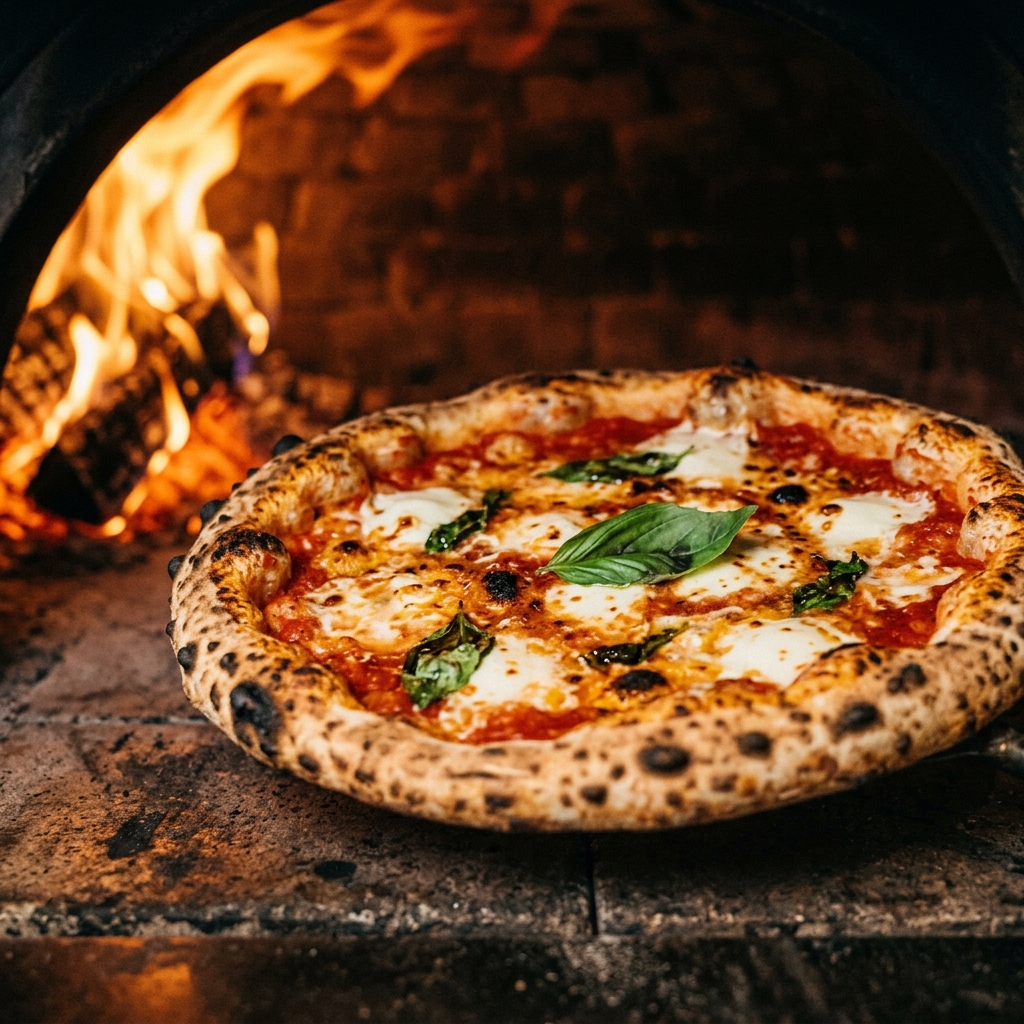
The brand challenge was precise: communicate Neapolitan heritage, artisan craft, and premium quality — without falling into the cliché of red-checkered tablecloths, clip-art wheat sheaves, and cursive Italian fonts that plague every 'authentic' pizzeria. We positioned Artisan Pizza at the intersection of tradition and refinement. The visual identity pairs a hand-drawn custom wordmark — imperfect, warm, human — with a precise typographic system and a colour palette built from the oven itself: charcoal blacks, fired clay oranges, flour-dusted creams, and copper accents drawn from the restaurant's custom dome. The photography direction treats every pizza like a still life: overhead shots on raw stone, close-ups of blistered crust texture, the flour cloud of a dough stretch captured mid-air. The brand feels like a craft — not a commodity.
Digital ordering that respects how people buy premium food
We designed the complete digital commerce experience: online ordering for pickup and delivery, a catering platform for corporate events, and a table reservation system — all unified under one product. The ordering flow was designed around a key insight from user research: premium food buyers don't 'add to cart' like they're buying commodity takeaway. They browse, they read, they want to understand what makes this pizza worth €18 before they commit. Every menu item is a micro-story — the dough process, the ingredient origin, the pizzaiolo's note on why this combination works. The catering flow handles the complexity that corporate buyers need: headcount calculators, dietary filters, event date scheduling, and a dedicated brief form for custom menus. We prototyped both flows and tested with 10 users — 6 regular customers and 4 people who'd never heard of the restaurant. The unfamiliar users spent an average of 3 minutes reading the menu before ordering. That's not friction — that's engagement.
A platform that runs as smoothly as a Friday night service
We built the website and ordering platform in Next.js with a headless CMS so Marco's small team can update the menu, toggle item availability during service, manage catering inquiries, and publish stories about seasonal ingredients — without any technical knowledge. The ordering system integrates with the kitchen's existing workflow: orders appear on a dedicated tablet display organised by time slot, with real-time status updates that customers see on their confirmation page. Payment processing handles both individual orders and corporate invoicing. The site loads in 0.9 seconds, runs flawlessly on mobile (where 73% of food orders happen), and includes a progressive web app option so regulars can install it directly on their home screen. We also built a simple loyalty mechanic: every 8th order unlocks a complimentary dessert pizza — tracked automatically, no stamp cards required.
The numbers told the story within 90 days.
Monthly revenue more than tripled. The combination of online ordering (capturing demand that previously bounced off the phone line), catering contracts (an entirely new revenue stream), and a 22% increase in average order value (customers spend more when they can browse a beautifully presented menu at their own pace) compounded into dramatic growth. Marco hired two additional kitchen staff and extended opening to seven nights.
The catering platform opened a revenue stream that didn't exist. Within three months, Artisan Pizza had recurring monthly catering contracts with four corporate offices within a kilometre radius. The average contract value was €4,200 — more revenue per event than an entire Saturday night of dine-in service. The brief form and headcount calculator meant Marco received organised requests instead of chaotic phone calls.
Customers ordering online spent 22% more than phone callers. The product design explains why: each menu item's micro-story (ingredient origins, dough process, pairing suggestions) created desire for premium options and add-ons. Customers who read about the 72-hour fermentation process were significantly more likely to choose the €22 Speciale over the €14 Margherita. The menu wasn't a list — it was a selling tool.
The platform loads in 0.9 seconds on average — critical for a food ordering experience where 53% of users abandon after 3 seconds. Lighthouse performance score: 96. The mobile experience is fully optimised with thumb-zone ordering, persistent cart, and one-tap reordering for returning customers. The PWA install rate among weekly customers: 34%.
Nearly three-quarters of all online orders come from mobile devices — confirming our mobile-first design decision. The ordering flow is optimised for one-handed use: menu scrolling, item customisation, and checkout all happen within thumb reach. Returning customers can reorder their last meal in two taps from the home screen PWA.
For fifteen years I focused on the dough, the oven, the ingredients. Imaginta focused on everything around it — and suddenly the world could see what my regulars already knew. The catering business alone changed my life. Last month I had corporate clients booking Christmas events in June. My biggest problem now is whether to open a second location. That's a problem I never imagined having.
Marco
Founder & Pizzaiolo, Artisan Pizza
Recognise this problem in your business?
Let's talk about building something similar.
Start Your Project